
BRASS AND BRONZE SCRAP
Brass and bronze scrap
We buy yellow brass in large quantities and bronze in smaller ones, but just as expertly. We separate the alloys and price each by its composition.
What we buy in brass and bronze
Brass and bronze are a family of copper alloys of varying value — yellow brass, turnings, fittings or B101 bronze all settle differently. We sort them by composition, so a valuable fraction never gets lost in a mix.
We serve metalworking plants, workshops, installers and independent scrap yards. On turnings and hardware we price with cleanliness and admixtures taken into account.
The most common alloys in this family. Mixed hardware we sort and price by fraction.
Yellow brass
Basic brass — fittings, hardware and turned parts; free of water meters, lacquer and paint.
M63 brass
Brass with a higher copper content — uniform production scrap, old sheet and “hair” swarf classified separately.
M58 brass (CW614N)
Free-cutting brass from machining — bar stock, hexagons and production scrap from turning.
M70 brass and brass tube
Tube cut to 1 m and parts in high-copper brass — classified separately from yellow.
Tinned brass
Tin-coated brass — classified separately because of the coating; free of hoses and ZnAl taps.
Brass cases
Clean cases, free of steel parts, lead and silicon.
Brass radiators (Ms, Ms-Cu)
Brass and brass-copper radiators — clean, free of steel parts and PVC.
Brass and bronze turnings
Waste from machining — settled by cleanliness and moisture from emulsion, separately for brass and for bronze.
Unsorted brass
Mixed commercial brass with light admixtures — we sort and price it by composition.
B101, B6 and B555 bronze
Tin bronzes — bearings, slides and valve parts; each grade priced separately from brass.
BK, BA and unsorted bronze
Silicon and aluminium bronze plus unsorted bronze with a copper content of at least 85%.
Fittings and hardware
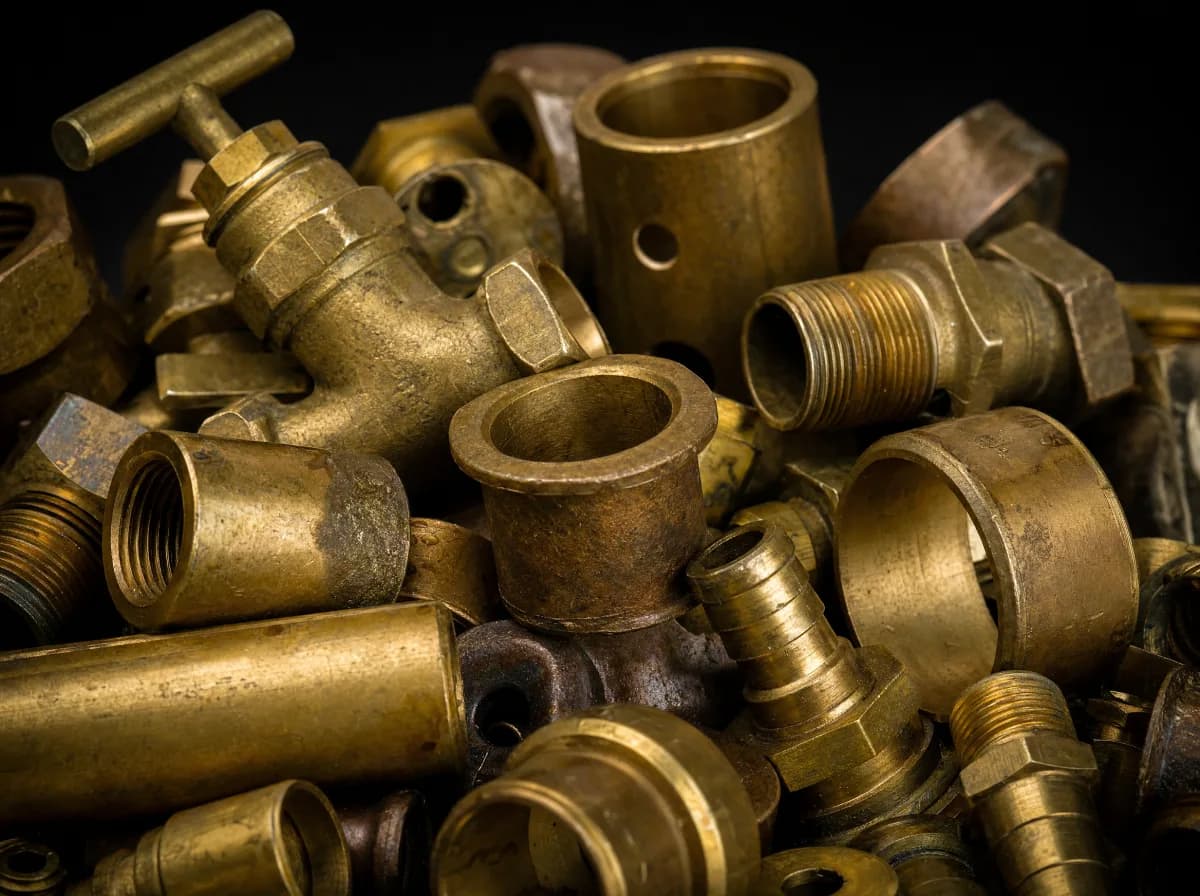
Valves, connectors and fittings — once steel parts and seals are removed.
What's in it for you.
We separate the alloys
Yellow brass, M63 and bronze have different values. We sort them instead of settling at one price, so the better grade works in favour of your price.
Turnings have value too
Brass turnings from machining are a fully-fledged material. We price them properly, taking cleanliness and moisture into account, rather than clearing them at a flat rate.
Straight to the foundry
We sell brass and bronze straight to smelting buyers and foundries. A shorter sales channel leaves more margin on your side.
Where to sell your brass and bronze
We buy brass and bronze at every non-ferrous branch. Pick the nearest one, or ask about terms for regular deliveries.
- Warszawa TargówekPrzecławska 2, 03-879 Warszawa · +48 516 041 683
- OtwockKraszewskiego 2A, 05-400 Otwock · +48 601 336 906
- ŁódźOkopowa 70/106, 91-849 Łódź · +48 506 054 883
- Poznań (Gądki)Zbożowa 1a, 62-023 Gądki · +48 505 118 482
- WrocławOpolska 19c, 52-010 Wrocław · +48 609 889 966
- BędzinSielecka 63, 42-500 Będzin · +48 601 367 273
- Gdynia (Trójmiasto)Handlowa 10, 81-061 Gdynia · +48 504 231 190
- Biała Podlaska · Jana Pawła IIal. Jana Pawła II 200, 21-500 Biała Podlaska · +48 602 892 944
- Biała Podlaska · BiałkaBiałka 59, 21-500 Biała Podlaska · +48 501 492 204
Quality standards
We accept brass and bronze freed of steel parts, rubber and plastics as far as possible. Cleaner hardware means a higher grade and less work at settlement.
For alloys that are hard to identify we reach for the handheld spectrometer — the composition analysis settles whether we have brass, bronze or another copper alloy, with no guesswork.
Brass and bronze — frequently asked questions
What is the difference between yellow brass, M63 and B101 bronze?
The alloy composition, and with it the value. Yellow brass is the basic alloy from fittings, hardware and turned parts — accepted free of water meters, lacquer and paint. M63 has a higher copper content and is classified separately from ordinary yellow. B101 bronze is a tin bronze from bearings, slides and valve parts; alongside it, B6 and B555 are settled separately, as are silicon and aluminium bronze. Odylion sorts these alloys instead of settling them at one price.
What is the difference between M63 and M58 (CW614N) brass?
Copper content and origin, and with them the grade. M63 has a higher copper share and reaches us mainly as uniform production scrap, old sheet and “hair” swarf. M58, also known as CW614N, is free-cutting brass from machining — bar stock, hexagons and production scrap from turning. Odylion classifies both grades separately, and high-copper M70 brass tube forms yet another item.
What if I don’t know whether I have brass or bronze?
The composition analysis settles it. For alloys that are hard to identify, the branch staff reach for a handheld spectrometer — the elemental measurement shows whether the material is brass, bronze or another copper alloy, with no guesswork.
Do you accept brass turnings from machining?
Yes, brass turnings are a fully-fledged material, not waste cleared at a flat rate. The price takes cleanliness and moisture from emulsion into account — the less moisture and admixtures, the higher the grade.
How should brass fittings and hardware be prepared for sale?
Ideally freed of steel parts, rubber, seals and plastics as far as it can be at source. Cleaner hardware means a higher grade and a smoother settlement; valves, connectors and fittings are accepted once cleaned that way.
Is it worth bringing mixed unsorted brass?
Yes — mixed commercial brass with light admixtures is accepted, sorted and priced by composition. Sorting at source does raise the grade of the delivery, though, because the more valuable fraction then does not get lost in the mix.