
Where the price of
your material comes from.
We don't publish a fixed price list because a reliable purchase price depends on the specific material. Instead, we explain the method, show the latest available quotations as a reference point and prepare a current valuation after we go over the material or photos.
Exchange quotations are a reference point — the final price depends on the grade, quantity and quality of the material.
Four things that
set your rate.
Quotations as a reference point
We start from exchange quotations (LME) in PLN per tonne. It's a market barometer — it shows the direction of the rate, but it isn't the price of your material. We show the latest available snapshot further down this page.
Grade of material
We classify over 400 items, so the valuation reflects the identified grade rather than one rate for the entire group. Millberry copper, chopped copper and Cu III unsorted are separate classes; so are aluminium profiles and cast alloy.
Quantity and logistics
For larger lots, we can arrange transport by agreement. Quantity, delivery method and a shorter sales chain — we sell directly to smelters and foundries — are among the factors considered when setting transaction terms.
Quality and cleanliness
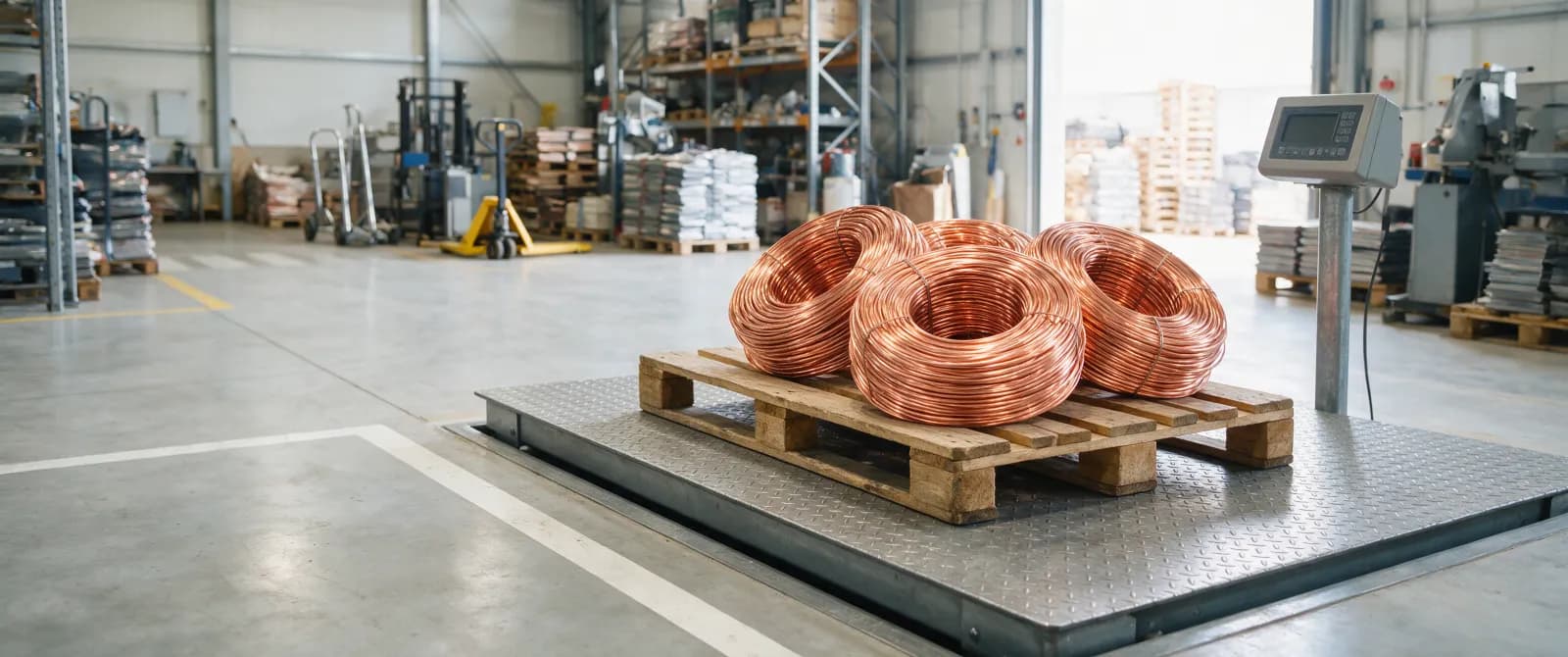
Moisture, contamination and the degree of mixing determine the final price. We assess them by hand and eye and weigh on authorised scales, and confirm unusual alloys with a handheld spectrometer — we pay for the material as it actually is.
Exchange quotations ≠ buying prices.
Current non-ferrous metal quotations in PLN per tonne: copper, aluminium, zinc, lead and nickel. We show them so you know we price to the market — but exchange quotations are a reference point, not a buying price list.
LME exchange quotations are a reference point — the final price depends on the grade, quantity and quality of the material.
The exchange (LME) quotes pure metals in bulk. Your material is usually an alloy, a product or a mix with contamination — so the buying price is derived from quotations, not a copy of them. Treat quotations as a market barometer: they show which way the rate is heading.
How much does a tonne of metal cost?
How much does a tonne of copper cost?
According to LME exchange quotations, a tonne of copper (Cu) is roughly 55,024 PLN (indicative quotations, as of 22/09/2026, 02:00). That's a reference point — the buying price depends on the grade, quantity and quality of the material. Check the quote for your copper on WhatsApp or by phone.
How much does a tonne of aluminium cost?
LME exchange quotations put aluminium (Al) at roughly 12,442 PLN per tonne (indicative quotations, as of 22/09/2026, 02:00). We set the final buying rate after we go over the material — it depends on the grade (e.g. profiles, sector, castings), quantity and contamination.
What is the price of zinc, lead and nickel in PLN per tonne?
Indicatively, per LME: zinc (Zn) about 14,834 PLN/t, lead (Pb) about 7,244 PLN/t, nickel (Ni) about 61,336 PLN/t (indicative quotations, as of 22/09/2026, 02:00). Exchange values are a reference point, not a buying offer.
Are metal quotations the same as buying prices?
No. Exchange quotations (LME) are a market reference point. The buying price of a specific material depends on its grade, quantity and quality — which is why we give the rate after we go over the material or photos.
How often do you update quotations?
Refreshes are scheduled hourly. When the source is unavailable, we show the last snapshot with its date.
In what currency do you quote metal prices?
In Polish złoty — PLN per tonne (PLN/t). We also show the USD and EUR rate from the same quotation moment.
WhatsApp is the quickest route to a current valuation.
Send photos of the material on WhatsApp or call — we'll prepare a valuation that reflects the current market and the information visible in the photos. It is more specific than a static table because it concerns your material. We reply within one business day.